
Morse taper (designated as MT — Morse Taper) is a universal tool fastening standard widely used in lathes and milling machines. Its main purpose is to ensuring reliable fastening of drills, reamers, countersinks and other cutting tools in the machine spindle.
Features of the Morse standard
- It has a conical shape with a certain angle of inclination (approximately 1.49°).
- Allows you to install the tool directly into the spindle without additional equipment.
- Various sizes are available: MT1, MT2, MT3, MT4, MT5, MT6, where an increase in the number means an increase in the diameter and length of the cone.
Dimensions of the Morse standard shank
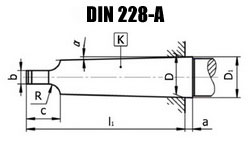
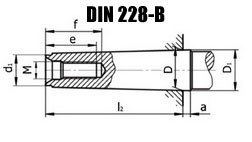
| K | a | b | c | d | d₁ | D | D₁ | e | f | l₁ | R | M |
|---|---|---|---|---|---|---|---|---|---|---|---|---|
| 1 | 3.5 | 5.2 | 13.5 | 8.7 | 9 | 12.065 | 12.2 | 16 | 55 | 62 | 5 | M6 |
| 2 | 5 | 6.3 | 16 | 13.5 | 14 | 17.780 | 18 | 24 | 31.5 | 75 | 6 | M10 |
| 3 | 5 | 7.9 | 20 | 18.5 | 19 | 23.825 | 24.1 | 24 | 33.5 | 94 | 7 | M12 |
| 4 | 6.5 | 11.9 | 24 | 24.5 | 25 | 31.267 | 31.6 | 32 | 42.5 | 117.5 | 8 | M16 |
| 5 | 6.5 | 15.9 | 29 | 35.7 | 35.7 | 44.399 | 44.7 | 40 | 52.5 | 149.5 | 10 | M20 |
| 6 | 8 | 19 | 40 | 51 | 51 | 63.348 | 63.8 | 47 | 61.5 | 210 | 13 | M24 |
Application of the Morse taper
The Morse taper is used in the following types of equipment:
- Lathes — for mounting tailstocks, drill chucks, centers.
- Milling machines — for mounting drill heads and cone chucks.
- Drilling machines — for fixing cutting tools directly to the spindle.
Advantages of the Morse standard
- Ease of use and tool replacement
- High concentricity and accuracy of fit
- Reliable fixation due to frictional force
- Wide compatibility with modern machine tools
Conclusion
The Morse taper remains one of the most popular standards in metalworking due to its reliability, versatility and convenience. It provides high precision tool installation and is widely used in professional workshops and production.